What makes Santa Barbara feel so distinct from other coastal markets? It is not just the ocean, the mountains, or the weather. It is also the architecture you live in every day. If you are buying, selling, or simply trying to understand what gives this city its lasting appeal, it helps to see how design shapes comfort, routine, and long-term value. Let’s dive in.
Why architecture matters in Santa Barbara
In Santa Barbara, architecture is part of the city’s identity, not just a design preference. The city has long recognized the value of preserving historic structures, including Spanish Colonial and Mexican-era adobe buildings, while shaping a business district defined by Spanish Colonial Revival and Mediterranean Revival architecture.
That identity became even more visible after the 1925 earthquake. As downtown rebuilt, planning efforts pushed a more unified Spanish Colonial vision that still defines much of the city today. For you as a buyer or seller, that means architecture here often carries both emotional appeal and market significance.
How climate shapes daily living
Santa Barbara’s mild climate helps explain why local homes are designed the way they are. NOAA climate normals for the Santa Barbara station show an annual mean temperature of 62.5 degrees, with summer highs generally in the upper 70s and winter highs commonly in the mid-60s.
In practical terms, that weather supports a lifestyle built around patios, verandas, courtyards, and shaded outdoor spaces. Features that might feel secondary in other markets often become central to daily life here. A covered entry, deep eaves, or a private terrace can change how a home feels morning to night.
Spanish Colonial Revival and Mediterranean style
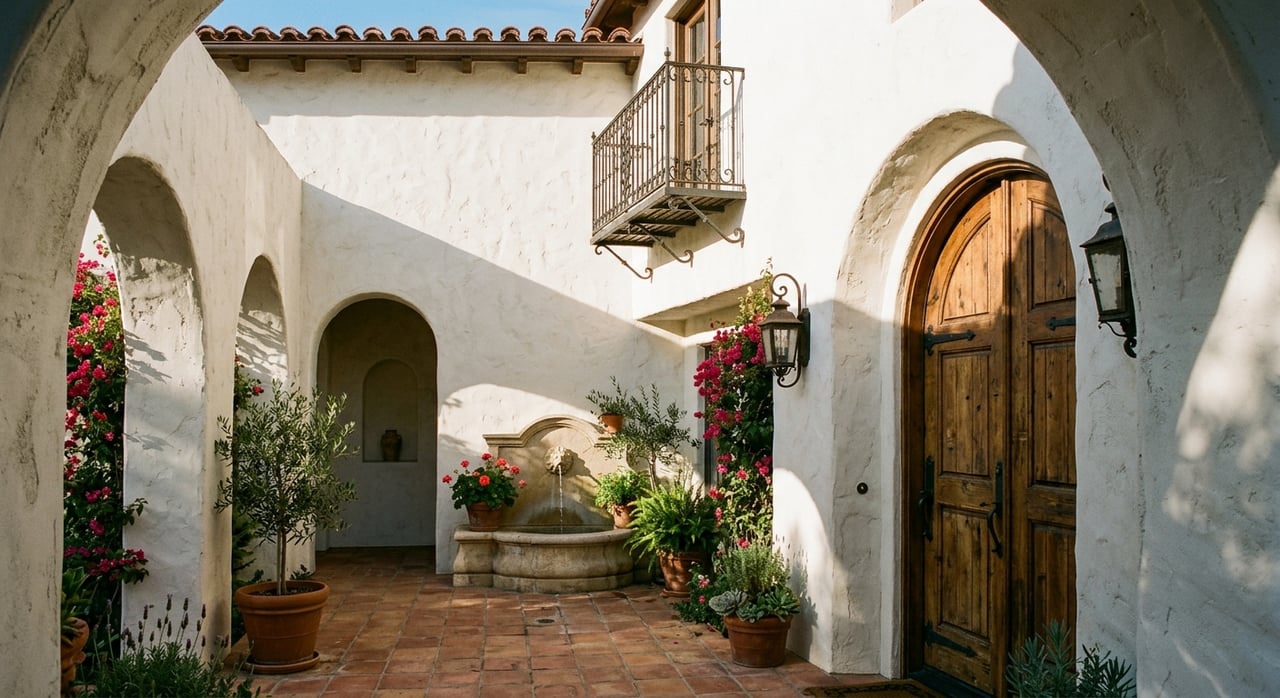
The signature Santa Barbara look is Spanish Colonial Revival, often closely related to Mediterranean Revival. The city’s design guidance describes features like smooth stucco walls, low-pitched clay tile roofs, arched openings, wood doors, recessed wood windows, patios, pergolas, and verandas.
These design elements do more than create curb appeal. They tend to shape a home that feels cool, shaded, and connected to outdoor living. Recessed entries and thicker wall surfaces can create a sense of shelter, while courtyards and arcaded walkways make it easy to move between indoor and outdoor spaces.
You can see this style most clearly in downtown, along State Street, in El Pueblo Viejo, and in areas such as the Riviera and West Beach. Civic landmarks also reflect this design tradition. The Santa Barbara Central Library and downtown Post Office, both completed in 1917, helped establish the city’s now-familiar architectural language.
Beyond revival styles
Santa Barbara is known for its Spanish character, but the local architecture is more varied than many people expect. The city identifies a range of historic styles including Adobe, Craftsman, Mission Revival, Italian Mediterranean, Italianate, Queen Anne, and Tudor.
That mix adds texture to the housing stock and gives buyers more than one path into the Santa Barbara lifestyle. A Spanish estate, a Craftsman bungalow, or an adobe-influenced home may all offer a strong sense of place, but they live differently on a day-to-day basis.
Craftsman homes and porch living
Craftsman homes are an important part of Santa Barbara’s history. The city notes a large inventory of Craftsman homes, and it also points to Victorian neighborhoods that remain part of the broader architectural landscape.
For daily living, Craftsman homes often feel more intimate and tactile. Features like porches, exposed eaves, and built-ins can create a grounded, human-scaled rhythm. The city also notes that the low-sloped Craftsman roof is well suited to California’s warm climate, which helps explain why the style fits naturally here.
Adobe and early Santa Barbara character
Adobe structures connect Santa Barbara to its earliest built history. The city and the Santa Barbara Historical Museum both point to traditional Mexican adobe buildings as part of the city’s early downtown fabric.
For you, that matters because adobe is not simply an old style. It is part of the architectural story that makes Santa Barbara feel rooted and visually consistent across generations. In a market where sense of place matters, these early influences still shape buyer perception.
Mid-century modern and coastal openness
Mid-century modern also has a real place in Santa Barbara. In 2023, the city designated the 1956 Thornton Ladd house at 1920 Garden Street as a Structure of Merit, highlighting features such as terrazzo detailing and large glass windows that bring the landscape into the home.
That interior-exterior connection is a major reason many buyers respond to mid-century and contemporary homes. Larger windows, cleaner lines, and more open planning can make natural light and views feel central to daily life. On a view lot or closer to the coast, that relationship to the outdoors can be especially meaningful.
Ranch and postwar practicality
Santa Barbara’s postwar neighborhoods added another layer to the local housing mix. The city’s San Roque survey shows the presence of Ranch and Minimal Traditional homes, often with horizontal massing, attached garages, patios, and larger lots in some areas.
These homes often appeal to buyers who want simpler circulation and a practical layout. Compared with earlier revival styles, they can feel less formal and more directly tied to everyday routines. That difference in feel matters when you are comparing homes that may be similar in size but very different in lifestyle.
How style affects light and flow
In Santa Barbara, style often predicts how a home will feel once you live in it. Spanish Colonial Revival homes tend to emphasize shade, privacy, and outdoor rooms. Craftsman homes often lean toward porch-centered living and a quieter, more enclosed rhythm.
Mid-century and contemporary homes usually prioritize daylight, landscape views, and a more open relationship between rooms. None of these approaches is universally better. The right fit depends on whether you want protected outdoor space, handcrafted character, broad natural light, or a more seamless flow to the landscape.
Architecture and ownership decisions
Santa Barbara architecture also affects what ownership looks like over time. The city’s preservation framework is designed to protect and enhance visual character, especially in historic districts where contributing structures make up the large majority of the area.
That means a home’s architectural style can influence more than appearance. It can affect how freely you may be able to change the exterior, expand, or alter visible features. The Historic Landmarks Commission does not review interior changes, but exterior alterations do require review and must remain compatible with the existing structure and surrounding neighborhood context.
For buyers, that can be a meaningful planning consideration. For sellers, it can be part of how a home is positioned in the market. Character and authenticity often add appeal, but future flexibility may vary from property to property.
What ADUs and updates may involve
Accessory dwelling unit potential can also depend on the property’s architectural and historic status. Santa Barbara’s preapproved ADU program is designed to help streamline permitting, but the city states that not all preapproved ADUs are allowed on properties with more than one unit or with historic resources, and some designs are not allowed in historic or landmark districts.
If you are evaluating a property with future expansion in mind, that distinction matters. A lot that appears to have straightforward potential may still require a closer look based on designation status and design compatibility.
Why the market responds to authenticity
Santa Barbara’s planning approach shows that style remains part of the city’s future, not just its past. In 2025, the city adopted objective design and development standards for certain multi-unit and mixed-use projects, including style groups such as Craftsman, Mediterranean, and Contemporary.
That ongoing emphasis helps explain why homes that feel authentically Santa Barbara often stand out. Whether the property is a preserved Spanish Colonial Revival residence, a well-kept Craftsman, or a thoughtfully designed contemporary coastal home, architecture tends to shape how buyers connect with the property and how they imagine living there.
What buyers and sellers should notice
If you are buying in Santa Barbara, it helps to look beyond square footage and finishes. Pay attention to how the architecture handles light, privacy, outdoor use, and circulation. Those details often have as much impact on your daily experience as the floor plan itself.
If you are selling, your home’s architectural identity may be one of its strongest assets. Distinctive design, original character, and a clear connection to Santa Barbara’s coastal lifestyle can all help tell a more compelling story in the market.
Architecture here is never just background. It shapes routine, atmosphere, flexibility, and first impressions in ways that are uniquely local. If you are thinking about buying or selling a Santa Barbara home with architectural character, Melissa Borders can help you navigate the details with local insight and thoughtful guidance.
FAQs
How does Santa Barbara architecture affect daily coastal living?
- Santa Barbara architecture often shapes shade, natural light, privacy, patio use, and indoor-outdoor flow, which all matter in the city’s mild coastal climate.
What architectural style is most associated with Santa Barbara homes?
- Spanish Colonial Revival is the style most closely associated with Santa Barbara, with common features including stucco walls, clay tile roofs, arches, courtyards, and recessed openings.
Are Santa Barbara homes only Spanish style?
- No. Santa Barbara also includes Adobe, Craftsman, Mission Revival, Italian Mediterranean, Italianate, Queen Anne, Tudor, Ranch, Minimal Traditional, mid-century modern, and contemporary homes.
How do historic districts affect Santa Barbara homeowners?
- In Santa Barbara historic districts, exterior changes are subject to review for compatibility, while the city states that interior changes are not reviewed by the Historic Landmarks Commission.
Can architectural style affect ADU plans in Santa Barbara?
- Yes. The city says some preapproved ADU designs are not allowed on certain properties with historic resources or in historic or landmark districts.
Why do buyers care so much about architecture in Santa Barbara?
- Buyers often respond to architecture here because it influences comfort, lifestyle, visual character, and how strongly a home feels connected to Santa Barbara’s setting and identity.
